
On 10 November 2026, the Google AI Edge team and the Android ML team announced that Automatic Speech Recognition (ASR) and Text-to-Speech (TTS) now ship in Google AI Edge Gallery, wired up so on-device small language models can listen and speak without a network connection.
For Android apps, the platform path they recommend is ML Kit’s GenAI Speech Recognition and Text-to-Speech APIs. The speech models are managed through AICore and Google’s on-device speech services, which means they do not have to be bundled in your APK. The same post also describes a cross-platform path with MediaPipe Tasks and LiteRT for teams that are not Android-only.
Advertisement

Why a separate speech pipeline
The post is explicit that multimodal models such as Gemma 4 can already take audio directly. Google still ships a modular pipeline—lightweight ASR and TTS beside the language model—for latency and flexibility. In the Gallery’s AI Chat feature, that split also lets them strip Markdown, skip code blocks, and schedule TTS sentence by sentence so synthesis does not contend with token generation.
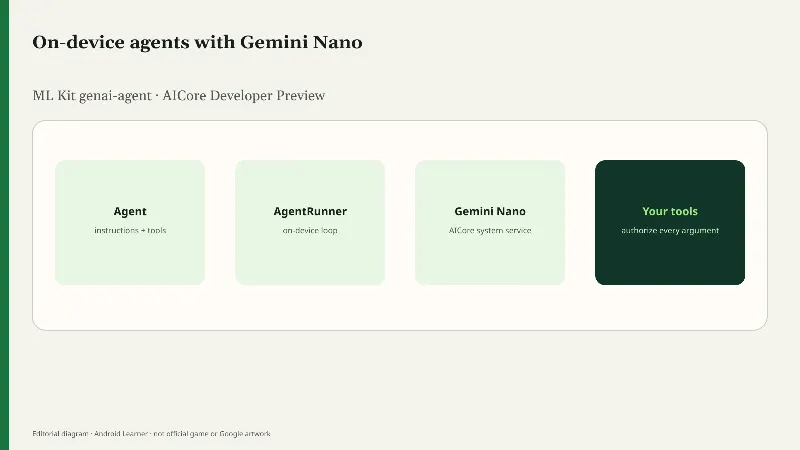
If you are building an Android app that already uses Gemini Nano, this is the cleaner integration: stream partial transcripts in, stream spoken replies out, and leave model management to the system where ML Kit is available.
What Google published about the Android (ML Kit) path
These figures are Google’s, from the 10 November 2026 post. They are not independent benchmarks.
Speech recognition (ML Kit GenAI Speech Recognition API)
- Streams live partial and final transcripts.
- Accepts the built-in microphone or an external audio stream (the post mentions smart glasses).
- Multilingual recognition across 100+ languages.
- Word error rate of 8.0% to 9.0% on FLEURS, as reported by Google.
- Transcription at 10× real time, described as about 300 ms per 3 seconds of speech.
- End-to-end speech-translation wait times cut by 35% to 44%, again as reported by Google.
Text-to-speech (ML Kit GenAI Text-to-Speech API)
- A compact, few-step diffusion model, accelerated on an NPU when one is available.
- Starts speaking in about 100 ms.
- 24 kHz audio, 8 expressive voices, 21 locales.
- Up to 50× real-time synthesis; Google’s example is a 27-second paragraph in about 500 ms.
- More than 50% lower active device power versus traditional autoregressive TTS, per Google’s comparison.
- Built-in earcon support.
Both models are described as integrated into the OS, adding 0 MB to your APK, with hardware acceleration on NPU and TPU backends when available, and with background model updates.
What shipped in the Gallery app
Two features in Google AI Edge Gallery are the reference experiences:
- XR Language Teacher — point the camera at a sign, menu, or object, ask a question aloud, and hear an explanation in your language plus pronunciation in the local language. ASR, the camera frame, and Gemini Nano (on Android) or Gemma 4 (elsewhere) run in a single on-device pass. A structured output schema tags foreign-language phrases so TTS can switch voices mid-sentence. The same idea extends to a paired phone driving intelligent eyewear; Google points to an Android Developer Summit talk on audio-first experiences for eyewear.
- AI Chat — dictation in, read-aloud out, with sentence highlighting, jump-to-sentence playback, and settings for pipelines, preset voices, and language packs.
The implementations are in the Google AI Edge Gallery GitHub repository. If you only need a voice loop around an on-device SLM, start there rather than inventing sentence chunking and Markdown stripping from scratch.
Cross-platform: MediaPipe Tasks and LiteRT
If you also ship iOS, desktop, or web, the same announcement describes MediaPipe Speech Recognition and Text-to-Speech tasks: framing, optional VAD, streaming or batch or hybrid transcription, and low-latency TTS with voice selection. The showcased open-weight bundles (packaged as .litertlm files) include Parakeet-TDT 0.6B (ASR), PocketTTS 100M, Kokoro-82M, and Phonon 31M (Google cites sub-100 ms time-to-first-audio for Phonon 31M on most devices). LiteRT is the inference layer underneath.
Those models are the open-weight path. They are not the same as the system ML Kit models, and they do have an on-disk footprint. Pick one stack per surface: ML Kit on supported Android devices when you want OS-managed models; MediaPipe / LiteRT when you need the same pipeline on multiple operating systems or a specific open model.
A practical integration order for an Android app
- Confirm the device can use AICore and the GenAI speech APIs. Have a silent fallback (typed input, or platform
SpeechRecognizer/TextToSpeech) when they are not there. - Request the microphone only while you are listening, and show a clear recording indicator.
- Subscribe to partial ASR results for the UI, but send the language model a final (or debounce-stable) hypothesis so you do not fire a completion on every token of speech.
- If you also run Gemini Nano, do not start TTS on a half-finished answer unless you are buffering sentence boundaries the way the Gallery chat sample does.
- Let users pick a voice and locale, and respect system captions / hearing accommodations.
- Measure latency and battery on the devices you support. Do not treat Google’s 100 ms / 50× / “50% power” numbers as a guarantee for your product.
Sources
- On-Device Speech Recognition and Text-to-Speech in Google AI Edge Gallery, Google AI Edge Team and Android ML Team, 10 November 2026.
- Google AI Edge Gallery (open-source reference app).
- What’s new in intelligent apps at the Android Developer Summit, 5 November 2026 (broader on-device intelligence context, including the eyewear talk).
Diagrams are original editorial illustrations for Android Learner, not Google assets.